
Little Stories: why certain images immediately tell a story
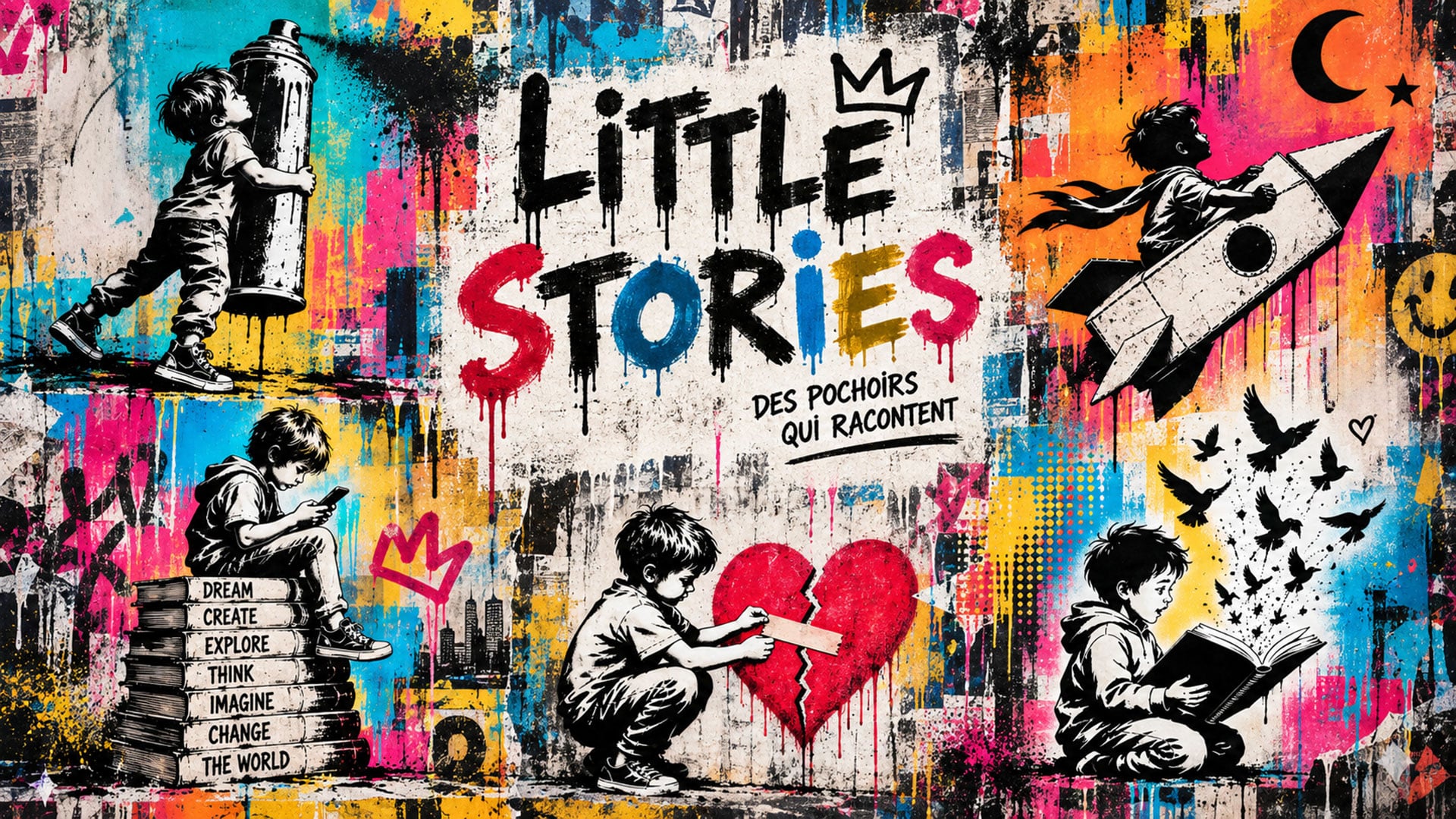
Some images can be understood in an instant.
Not because they are simple. Not because they show a familiar subject. But because something is happening.
A lone character can be beautiful, strong or expressive. But as soon as you give them an action, an intention, a problem, a contradiction, the image starts to tell a story.
This taste for scenes that tell a story is not new in our collections — Amour Naissant was already exploring childhood and emotions in its own way — but Little Stories allows us to move into more varied registers.
It is in this spirit that we have conceived Little Stories, a collection of street art stencils around childhood, imagination, emotions and sometimes a more critical view of the world around us.
Some stories make you smile. Others are more tender, sadder or more sarcastic.
But they are all based on the same idea: give enough for a story to begin, without ever finishing it in place of the artist.
A story begins when something happens
There is a difference between representing a subject and telling a story with it.
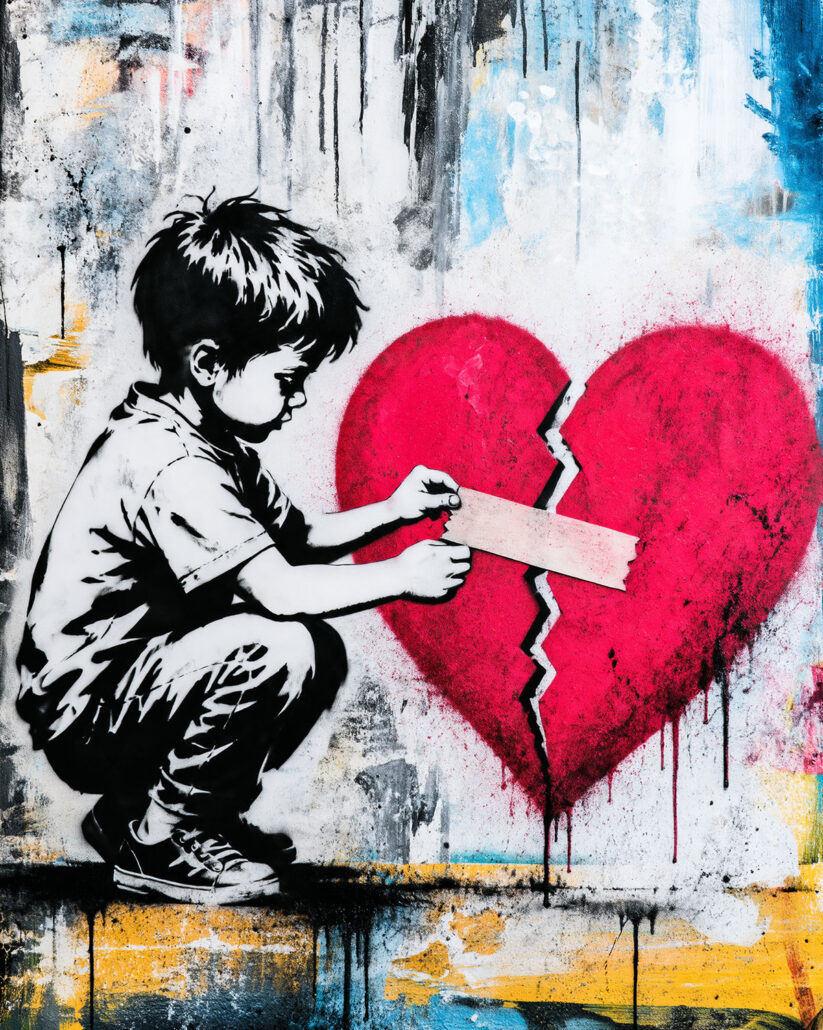
A broken heart is a symbol.
A child trying to fix it becomes a story.
A rocket is an object.
A child taking their place in a cardboard rocket is already telling another story: a desire to leave, an imagination in motion, perhaps a journey that exists only for them.
What creates the story is therefore not necessarily the complexity of the image. It is often the relationship between a few elements.
A gesture.
A disproportion.
A contradiction.
An object used in an unexpected way.
Sometimes, very little is needed to make us see not just a character, but a situation.
And as soon as there is a situation, our mind naturally begins to look for what happened before, what is happening and what might follow.
Understand quickly, think afterwards
A powerful scene must be able to be read quickly.
This is particularly true in street art, where the image can be discovered from a distance, in motion or in the middle of an already very cluttered environment.
The first level of reading must work almost immediately.
We understand the situation.
Then only come the questions.
Why is this heart broken?
Why is this child trying to fix it?
Where does he think he's going, the one who built himself a rocket with a few pieces of cardboard?
This second stage is essential, because it transforms a readable image into an interesting one.
If everything is explained at first glance, there is not much left to discover.
Conversely, if the scene is so dark that it requires a lengthy explanation, it loses some of its impact.
Therefore, a balance must be found: an idea clear enough to be understood immediately, but open enough to keep working in the mind of the person looking at it.
The detail that changes everything
In a narrative image, not all elements have the same importance.
Some dress the stage.
Others carry the history.
Take a spray paint can. At normal size, it doesn't say much on its own. But when it becomes almost as big as the child trying to carry it, the situation changes immediately.
There is suddenly effort, exaggeration, humour, perhaps even a form of obstinacy.
Same thing with a cardboard rocket.
If it were to become perfectly realistic, some of the charm would vanish. The cardboard tells us that this adventure is made with next to nothing, and above all that it exists first in the child's imagination.
And sometimes, the detail doesn't just transform the scene: it literally opens a passageway.
A child looking through a hole in a wall, that's an image.
But if this hole is itself drawn by the child, then the scene changes completely. He is no longer simply looking elsewhere: he created his own opening to somewhere else.
That is almost a short definition of the imagination.
The detail is therefore not necessarily there to embellish the image.
It can be what gives it its full meaning.
This is an interesting question to ask oneself in front of a scene: what element could be removed without losing the idea?
If the answer is «none of the important items», it's often a good sign.
Not all stories need to be well-behaved
Little Stories is very much about imagination and childhood, but the collection doesn't necessarily strive to remain sweet or nostalgic.
An image can also be used to criticise.
To be provoked.
Enough to bring a wry smile to one's face.
Putting into words something one does not necessarily want to spell out.
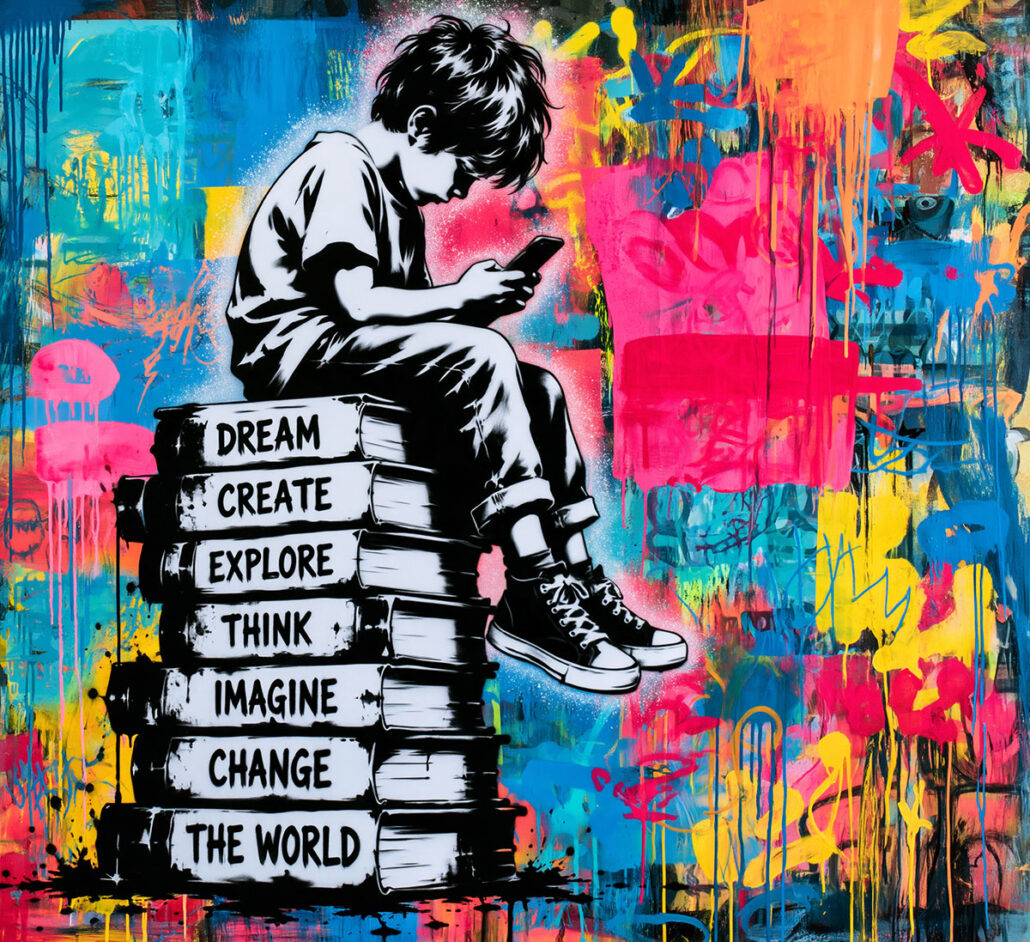
The child sitting on a pile of books, engrossed in their phone, is a good example of this.
On books, words invite us to dream, create, explore, think, imagine, change the world.
And meanwhile, the character's entire attention is captured by their screen.
Here, the contradiction carries almost the entire image.
The criticism is intentional.
She talks about the time we spend on our phones, what sometimes ends up taking a back seat, and how our attention is constantly being hijacked elsewhere.
And the fact that the character is a child doesn't really protect adults from the message.
This type of scene can speak to an artist who is looking for something other than a decorative image.
Someone who wants to express annoyance.
To get an idea across.
To be a bit more rebellious.
Because a stencil can also be used for that.
Leave space for the viewer
A scene can have a point of view without imposing a single interpretation.
That is an important distinction.
The child on the phone makes a fairly clear critique. But the artist may decide to make it harsher, more ironic, or, conversely, more melancholic.
A mended heart can evoke hope for one person, and fragility for another.
The cardboard rocket can be simply joyful, or give rise to a form of nostalgia.
The child looking through the opening they have just drawn can evoke curiosity, escape, creation or the need to look beyond what they are given to see.
Therefore, what matters is not to make the scenes deliberately vague.
It's not to close them.
A good image can say something whilst leaving a degree of freedom to the person looking at it.
And even more to the one who's going to paint it.
The stencil as a starting point
It is an important principle in the way we work: A stencil is not a finished work of art.
He brings a form, a scene, sometimes an idea.
However, he decides neither the painting, nor its atmosphere, nor its final message.
The background, colours, materials, pattern size, its position in the composition, the words the artist chooses to add, the other elements with which it is combined... all of this can profoundly change what the image tells.
The exact same scene placed against a very dark background does not produce the same sensation as it would on a bright composition.
A character almost lost in an empty supermarket does not have the same presence as a character surrounded by signs, colours and textures.
Two stencils brought together can even create a story that didn't exist in either of them to begin with.
This is also why the visuals that accompany our stencils must be seen as inspirations, never as works to be reproduced identically.
They show a possibility.
Not an answer.
The stencil tells the beginning of the story. The artist decides the rest.
Discover Little Stories
Scenes to interpret, transform and integrate into your own artistic universe.
-
New!
-
New!
-
New!
- New!
-
New!


When an image becomes a playground
That is perhaps where children truly come into their own in Little Stories.
They make it possible to make natural situations that, with an adult, would immediately seem absurd.
A cardboard rocket can become a real means of transport.
A hole drawn in a wall can become a window to somewhere else.
A book can set a whole world free.
An object that is far too big can become a perfectly reasonable challenge.
The logic of childhood more easily accepts detour, exaggeration, and dreams.
But it also allows us to look at our world differently.
Sometimes with innocence.
Sometimes with humour.
And sometimes with a rather disarming frankness.
It is this blend that interests us.
Not to choose between poetry and criticism.
Between the smile and something more uncomfortable.
Allowing several perspectives to coexist within the same collection.
Little Stories
Little Stories brings together scenes designed to trigger something.
An emotion.
A question.
A smile.
A review.
Or simply a desire to paint.
The collection will continue to grow gradually, with new stories and different tones. Some creations will also be reserved for members of The Invisible Workshop.
But the idea will remain the same: to offer enough for a story to already exist, while leaving enough freedom for each artist to transform it.



 Français
  English (UK)
  Deutsch
  Español
  Italiano
  Nederlands